Figure 1 shows the use of the term gender in the House of Commons Hansard Corpus.
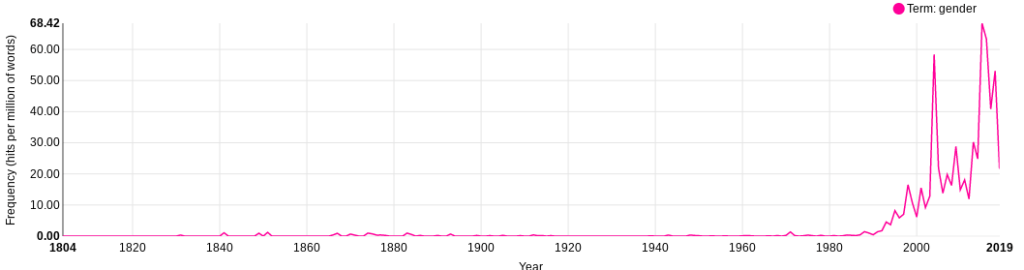
Figure 1 shows that the term was not used until the early 1990s. After this time, there is a rapid increase in use, peaking at 2004 and 2015. These peaks may be related to the legislation that was being debated at the time.
A huge leap took place from 2004 to 2005. At these times, terms such as gender recognition, gender discrimination, gender equality, gender imbalance and gender pay gap are being used in the House of Commons. For example, in 2005 Barbara Follett stated that “we have an enormous amount to do if we are to achieve goal 3 and eliminate gender disparity in primary and secondary education by 2015” within the House of Commons.
A review of the House of Commons debates at that time reveal that a number of gender based policies were being discussed.
One of the policies that was being discussed was gender recognition, with the Gender Recognition Act being passed in 2005. Figure 2 tracks the use of the term gender recognition between 1980 and 2019.
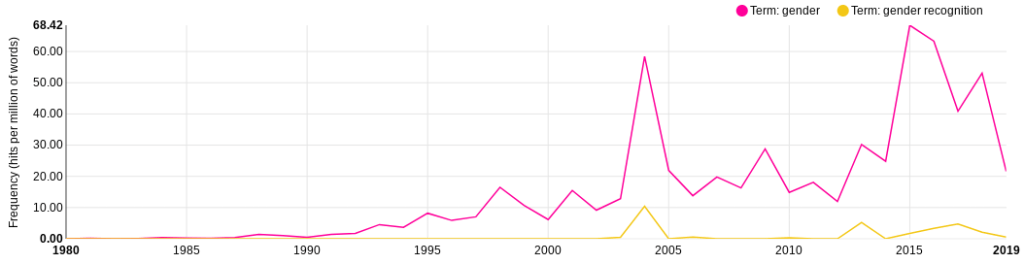
The Gender Recognition Act allowed people who have gender dysphoria to change their legal gender.
Another gender based policy that was being discussed around this time was gender pay gap. Figure 3 tracks the use of the term gender pay gap between 1980 and 2019.
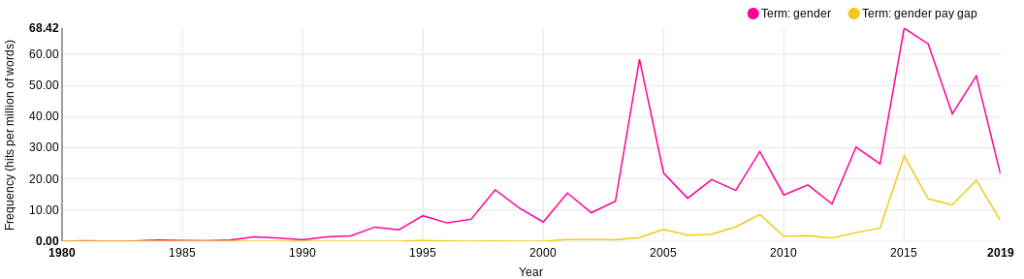
Figure 3 shows that there was no large increase until the year of 2015, where a legislation which forced firms with more than 250 employees to publish the average pay of male and female employees was introduced. There was again a smaller peak in 2018, when this legislation was reinforced, after a loophole was found by some firms.
The Colonial Period
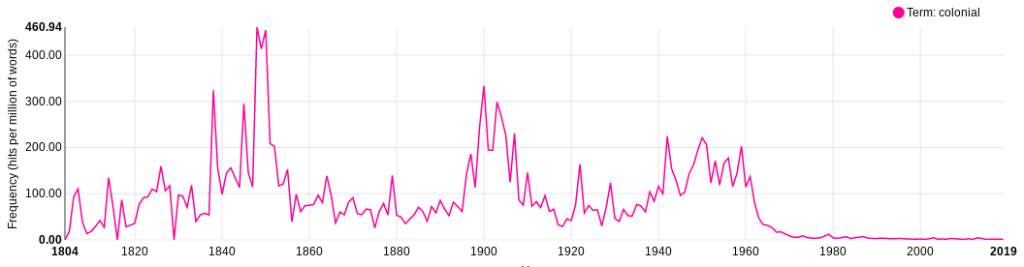
Figure 3 (seen above) shows the use of term colonial between the years 1804 to 2019. It shows that the term was already in use by the 18th century, most likely due to the fact that colonies were established from as early the 17th century. The figure also shows that there are a number of peaks across this time period, with a sharp drop off in the 1960s.
The peak around 1848-1850 may be due to new colonies being set up around the world. These colonies were set up in countries such as Canada, Australia and India. For example Mr William Keogh stated in 1850 that “the right hon. Baronet himself had moved a vote of thanks to the victorious general of the troops in India”.
The spike in mentions in the year 1900 may be due to the fading power of the British Empire. In this time period, many colonies started to demand the right to independence. The fading power was due to the Empire spreading their military too thin around the world. This was seen by the war fought between the British Empire and two Boer states, and was known as the Second Boer War.
The drop off in the 1960s was due to the UK abdicating the last of it’s power back to the colonies, so they become countries of their own.
 The Mapping of Political and Linguistic Trends